

Reviews
HIFIMAN HE1000 WiFi Headphones Review
HE1000 WiFi — HomeTheaterHifi · Chris Groppi
HomeTheaterHifi · Chris Groppi Original article

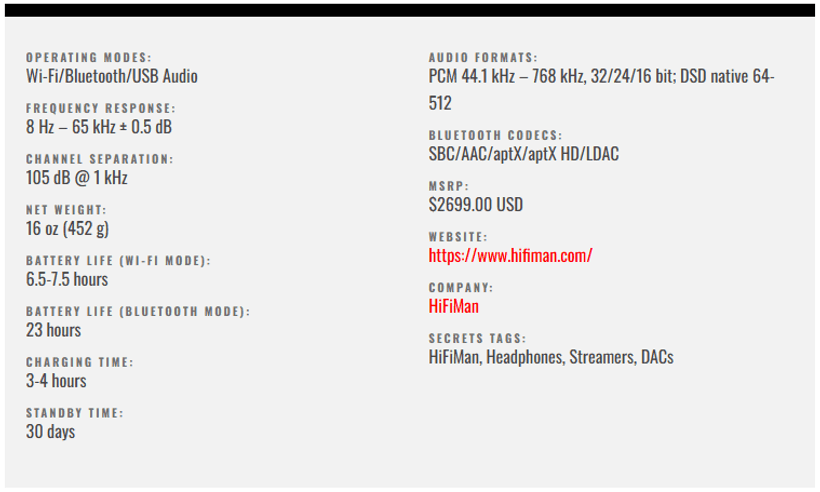
At $2699, the HIFIMAN HE1000 WiFi is not cheap. But it’s an all-in-one product that’s a solid value. You’d have to spend as much or more on a streamer, DAC, amplifier, and passive headphones to equal them.
HIFIMAN HE1000 WiFi Headphones
- Top-notch sound quality.
- Very good build quality with luxury materials.
- Built-in high-performance streamer, DAC and headphone amplifier.
- Works with DLNA apps, Qobuz and Tidal for high-res streaming.
- Can be used with a USB-C wired connection without WiFi.
- Bluetooth with all major codecs for mobile listening.
- Planar magnetic design
Wireless headphones, at least until recently, have been mass market convenience products. Even with modern “audiophile” codecs, Bluetooth headphones still play music transmitted with lossy compression, turning your high-res files into glorified MP3s. This is a harsh but true statement. Recently, a few manufacturers have come out with headphones that use a WiFi connection to get around the limited bandwidth of Bluetooth. This new generation of headphones can play full high-res files with no compression and still deliver wireless convenience. HIFIMAN has recently released two WiFi models that give the wireless treatment to their well-regarded Arya and HE1000 headphones.
I review the HE1000 here. Lory Hawley is reviewing the Arya WiFi for Secrets as we speak. Why are these types of headphones so rare and new? It’s because they must include so much. A WiFi headphone needs to have a built-in amplifier, DAC, and WiFi streamer plus batteries to power it all. That streamer is a full embedded computer. It’s an awful lot of technology to pack into a pair of headphones and needed modern advances in System on a Chip embedded computers to make possible. But now it’s here. The question is, does it deliver the sound quality goods in a convenient, easy-to-use package? For the most part, yes, if your use case fits what the headphones were designed to do.


The HE1000 WiFi are based on HIFIMAN’s well-regarded HE1000 open-back planar magnetic headphone. That fact tells you almost all you need to know about the use case that these headphones are designed for. They’re open-backed, meaning they have zero, and I mean zero, sound isolation from the outside world. They have no noise cancelling either. So, these are definitely not meant for listening on the go or in airplanes, just from their basic design. The design of the WiFi connection reinforces that.
They are meant to be paired with the same WiFi network that your source device (either phone or computer) is on. They really don’t have a way to directly connect with your phone over WiFi when not around a real network. You could, in principle, put them into setup mode, where they appear as their own WiFi network and play to them with a suitable device connected to that network. If you do that, you’ll be limited to playing locally stored music because you won’t have an internet connection.
HIFIMAN suggests a portable hotspot to which you can connect both your phone and the headphones if you really want to listen on the go. But they’re really meant to be used at home on your normal WiFi. Their wireless nature means you can wear them anywhere around the house with no constraints, getting top-quality sound. HIFIMAN warns users about mesh networks causing potential stuttering and dropouts, but I didn’t experience any major problems with my home’s 3-station mesh network.
In addition to the WiFi connection, you can plug the headphones into a computer with a USB-C cable. The headphones will appear as a USB DAC, and you can listen away in that manner. This is how I used them at work in my office. My university has one sub-network for normal devices like phones and computers and a different one for embedded devices with no interface. This means the phone and the headphones would be on separate networks. Knowing the IP of the headphones, I could still reach them for setup, but my player apps couldn’t see them. Some apps allow manual connections if you know the IP of the device, but some don’t. And with DHCP, the headphones will change address every time they connect.
Anyway, enough with the geek speak. It was just too complicated, so I used the cable. And HIFIMAN does warn users that the HE1000 WiFi won’t work in “complex” network environments. What they mean is enterprise institutional WiFi networks with extra security layers and multiple subnets. So, keep this in mind for your use case. If you are primarily thinking of these for listening at home with cable-free convenience, go for it. That’s what they are for. But if you were thinking of these for travel, listening out and about, or listening at work (if your work has something fancier than a normal home-like WiFi network), you may want to reconsider.
They do, however, have a third connection option that is good for out and about. They also have Bluetooth, and that Bluetooth is equipped with all the latest codecs. This is not as good as the WiFi, of course, but will allow you to listen on the go in a pinch, at least with an Android phone, that is. iPhones do not support high-res Bluetooth codecs by default, only standard Bluetooth. You can add an aftermarket high-res Bluetooth dongle to make this work if you want. I use an iPhone, and I didn’t have a suitable dongle, so I did not test the HE1000 WiFis in Bluetooth mode seriously. Just enough to prove it worked.
The design of the headphones themselves is befitting of their cost. There is almost no plastic. Only the buttons for power, volume, and source select, and a rubber pad at the top of the metal outer headband. Everything else is either aluminum or leather. The headband uses a traditional adjustment mechanism with satisfying clicks, a suede leather perforated headband, and super soft earcups. The open-backed grille is a laser-cut honeycomb, revealing the planar magnetic driver inside.
Their weight is an even 1 lbs. I found the HE1000 WiFi to be a very comfortable headphone, if not quite as comfortable as my reference Dan Clark Audio Stealths. At least on my head, the HE1000 wanted to shift forward and back a little as I moved around, but this is a minor quibble. I was able to wear them around the house for extended periods of time with no discomfort.
As you’d expect with headphones of this price class, they come in a beautiful presentation box you can use for storage. As they are not meant for mobile listening, they do not fold up and do not come with any sort of portable case.
Internally, the headphones use HIFIMAN’s Himalaya R2R ladder DAC, implemented primarily on a small FPGA. This DAC supports up to 32-bit 768 kHz PCM and DSD 512 and everything in between. A parallel R2R ladder DAC eliminates the delta-sigma one-bit reconstruction in favor of a parallel digital output driving a resistor ladder. In principle this is “better,” but of course the devil is in the details of any DAC implementation. The headphone amplifier is stated as Class A, but no other details are published.
The streamer section supports DLNA, Qobuz Direct, Roon, Apple Music and Spotify. Tidal support is not included via the Tidal app but should still work from a 3rd party app that uses DLNA like mconnect player. I’m a Qobuz guy, so that’s what I mostly used. The headphones worked equivalently with both the Qobuz app and the plugin in mplayer. Since this is an all-in-one product, it’s not like you have the choice to use a different DAC, amplifier, or streamer. All the electronics work together, so what really matters are my listening impressions below. These electronics are combined with the HE1000 planar magnetic driver, using a sub-micron thickness diaphragm with HIFIMAN’s proprietary surface coating technology and their most up-to-date magnet technology. The headphones do not support any sort of crossfeed. Some players can do this (like JRiver Media Center), but none of the phone-based apps can do it. It would be nice if this feature could be implemented in the headphone streamer firmware. I prefer some subtle crossfeed, personally.
I also found their battery life to be very good, especially on standby. They could sit for days or even weeks without any problem. I could get several multi-hour listening sessions in before needing to recharge (with a USB-C charger). They have no battery life display. You’ll get a blinking LED warning of low battery, but that’s it.
When powered on, the headphones default to Bluetooth mode. Pressing the source select button for about 1 second cycles them through WiFi and USB-C modes. When entering WiFi mode, the firmware reboots the headphones to connect to WiFi, which takes a few seconds.
Setup is fairly simple, at least with the correct directions. The printed manual shipped with my very early HE1000s did not match reality. HIFIMAN sent me some YouTube instructional videos to fix that. Bluetooth pairing is straightforward. WiFi is similarly easy, although it takes a few more steps. The headphones initially appear as their own WiFi network for setup. You connect to that network, then go to the IP address of the headphones provided in the instructions in a web browser. That brings up a simple interface to connect to your local WiFi network and to update the firmware. I found that the “manual” firmware update works as expected, but the internet-based update from the web interface did not. Once the network information is entered, the headphones will reboot and connect to your WiFi network. To change networks, you need to reset the WiFi system and repeat the process. The headphones cannot be configured to work with multiple networks. USB-C is the simplest. Just use the source select button to enter USB-C mode and plug them in.
The buttons all feel the same when the headphones are on, so it’s important to not accidentally switch modes while trying to adjust the volume. I did that a few times. Once set up, I had no usability issues except for a few short stutters and dropouts likely related to my mesh networking or my sometimes-janky home internet service. The HE1000 WiFi headphones were also the first device to work natively with the Qobuz app, my personal favorite streaming service. I usually use the mconnect player to use Qobuz with DLNA devices since the Qobuz app tends to not see them. But the HE1000 WiFi headphones work great here. I did have a few weird problems with Qobuz sometimes giving an error trying to play certain tracks or having a brief stutter at the beginning of tracks, but I don’t think this is any fault of the headphones.
Finally, HIFIMAN is working on an app to configure the headphones and provide some additional functionality, including monitoring remaining battery life. For now, that app is only available on Android. I was able to try out a beta version of the iPhone app. For now, it can perform network configuration and streaming firmware updates. It will eventually add EQ adjustment, but that part of the iPhone app is not ready yet. All this functionality worked fine and was more convenient than the built-in web interface.
I listened to the HE1000 WiFis primarily using Qobuz streaming through the Qobuz iPhone app. I also tested the Qobuz plugin and DLNA streaming with the mconnect player, which also worked great. Apart from a few network-related hiccups described above, this process was pretty seamless. The only issue that was semi-regular was a brief stutter at the beginning of playing a new track. I still think this is network-related. It would happen with some albums but not others and was not necessarily repeatable day to day. Anyway, it was minor and didn’t really compromise my listening experience in a meaningful way.
One thing that I really like about Qobuz is that it allows me to stay current with new music, or at least music that is new to me. I listened to many of my new favorites with the HE1000 WiFis at home and listened to many of those same albums on my reference headphone setup I keep on my desk at work. That system consists of Dan Clark Audio Stealth headphones, a Mytek Liberty THX AAA amplifier, and a Chord Mojo DAC connected to my desktop computer via USB. I use the Qobuz desktop app as the player. This setup has an MSRP of more than double that of the HE1000 WiFi, so keep that in mind for the comparisons below.
The first thing I noticed was a distinct similarity between my reference setup and the wireless headphones. Both offered a great sense of space, openness, clarity, and ease in the sound. Another key hallmark was tonal neutrality and no overemphasis on any particular part of the sonic spectrum. This last one is a big pet peeve of mine, especially in the bass. Many headphone manufacturers, even ones selling decidedly high-end products, overemphasize the bass to compensate for the lack of physical impact as compared to loudspeakers. This may seem initially impressive, but I consider it a flaw. My favorite IEMs, the HIFIMAN RE800, get this right. The bass is tonally balanced with the rest of the sound, not cartoonish. The HE1000 WiFis do the same. There’s plenty of bass impact, depth and drive, but the balance is completely natural.


Stereolab, “Instant Holograms on Metal Film” and Courtney Barnett, “Creature of Habit”
Two great examples are Stereolab’s new album “Instant Holograms on Metal Film” and Courtney Barnett’s new album Creature of Habit. The Stereolab album is one of the best downtempo electronica albums I’ve heard in a long time. It’s my favorite electronic genre, but lately I’ve been listening to a lot of 90s and 2000’s Kruder and Dorfmeister and Thievery Corporation because new stuff seems boring and derivative. The Stereolab album is the first I’ve heard in years where I’ve said to myself both “This is new” and “This is good.” As with a lot of electronic music, there’s lots of bass depth, texture and impact throughout the album. In comparison with the reference setup, the impact is just a little less pronounced, but it’s close. The Courtney Barnett album deviates from her normal formula with more rock and more power. The HE1000s deliver the basslines and drums in spades. Again, a little rounded off compared to my reference setup but still very good.


The Avalanches, “Frontier Psychologist” and Bebel Gilberto, “Tanto Tempo”
Extraction of detail with the HE1000s is excellent. The Avalanches “Frontier Psychologist” is a track composed entirely of samples woven together. Each of these samples has its own sonic character. Part of the art is how those sonic characters combine and play off each other. The detail extraction of the HE1000s clearly portrayed all those differences in a way that was supremely interesting and satisfying. Here, I don’t think the HE1000 WiFis lose anything to my reference setup. Same with the texture of the vocals in the remastered version of Bebel Gilberto’s Tanto Tempo, one of my favorite albums. All the depth and texture of Gilberto’s voice is delivered at the maximum.

Of Montreal, “The Sunlandic Twins”
Another fun album I listened to was Of Montreal’s The Sunlandic Twins. The track “Wraith Pinned to the Mist and Other Games” is one of my favorite modern rock songs. I’ve been to Antarctica 7 times and met my wife there in 2016. This song (it features Antarctica) really speaks to me. I’ve listened to it a lot. I noticed one small shortcoming with the HE1000s here as compared to my reference setup. Even though the reference headphones are closed-back, they are the most “open” sounding headphones I’ve ever listened to. The HE1000s give up a little here, with the soundstage a little closer to the head and a little less air and space than the Dan Clarks. Not that the HE1000s sounded “closed,” mind you. Just a little bit less open and spacious. If I didn’t have those 1000 lbs. gorillas to compare to, I might not have even noticed.
The HIFIMAN HE1000 WiFi headphones are by no means cheap at $2699. But you get an all-in-one setup with a streamer, DAC, and amplifier built in to go along with the headphones.
- Handsome looks and very good build quality.
- Superb sound quality.
- Hands-free wireless convenience delivering high-res audio over WiFi, plus advanced Bluetooth codecs for on-the-go listening.
- Built-in headphone amplifier, DAC and streamer.
- An iPhone-compatible configuration app.
- Crossfeed support in hardware.
- Better written documentation.
- Battery life indicator on the headphones.
If you had to buy all those pieces separately and get the same sound quality, you’d spend just as much or more. Combine that with the hands-free convenience and world-class sound quality, and the value question tilts in their favor. If the limitations of the headphones fit how you want to listen, I consider these headphones an excellent value.
The HIFIMAN HE1000 WiFi headphones are a great technical achievement. They offer world-class headphone sound that was right up there with my more than twice as expensive reference headphone rig, all while having wireless convenience. They’re not cheap, but they are all-in-one, with a built-in streamer, DAC, and amplifier. If the idea of a “buy it once and leave it alone” product is attractive to you, and your use case is to primarily listen at home or another quiet environment with a “simple” WiFi network setup, these headphones are ideal. Who are they not for? Someone who wants wireless headphones primarily for travel or on-the-go listening. The HIFIMAN HE1000 WiFis are not made for that.